

MARCOGAZ’s technical recommendations for European gas industry to reduce and eliminate venting and flaring
21 September 2021 | News
The findings of MARCOGAZ highlights the importance of defining the notion of proportionality, which could lead to a reduction of emissions at a reasonable cost
The technical report MARCOGAZ prepared in the aftermath of a survey conducted in cooperation with Gas Infrastructure Europe (GIE) earlier this year, provides definitions for the five most prevalent methane emission types to draw a precise scope of possible reductions. The definitions include: vented emission, flaring, routine venting/flaring, safety venting/flaring and non-routine venting/flaring.
The report identifies which venting and flaring methane emissions are avoidable or non-avoidable in the midstream and downstream European gas industry. It also lays out the extent and technical conditions for the avoidable emissions with reference to best available technologies (BAT).
Origins of vented emissions
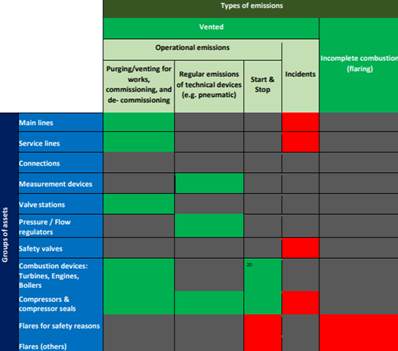
MARCOGAZ finds that most of the vented emissions in midstream and downstream in the surveyed countries[1] are related to operational activities and incidents, 90.2% and 9.1%, respectively. When extrapolated to the EU level, the ratio changes very little. At the EU level, operational activities account for 86.3% as the origin of the venting and flaring emissions from EU mid and downstream gas infrastructure. Incidents and incomplete combustion respectively make up 12.6 % and 1.1% of such emissions.
According to survey results, operational emissions are avoidable for the majority of assets. While incidents are unavoidable, some mitigation is possible under rare conditions. The main BAT for mitigation of emissions is a proper work permitting system for third parties.
In the mid and downstream sector, there is no reason to vent or flare to balance production and demand as is the case in the upstream. None of the gas in mid and downstream infrastructures must be vented or flared because it cannot be dispatched to the market. Neither the routine venting and flaring is entirely avoidable nor is the non-routine venting and flaring completely unavoidable.
MARCOGAZ’s proportionality criteria
MARCOGAZ accordingly introduces the notion of proportionality criteria, essential to distinguish operations that could lead to a reduction of emissions at a reasonable cost and operations that require a heavy investment for small volumes of methane avoided. Therefore, the report recommends including proportionality criteria in the respective legislation, allowing to consider small amounts of venting and flaring as non-material.
Moreover, the report of MARCOGAZ lists five most cited BATs in the survey as the most common solutions to mitigate methane emissions. The techniques include:
- Reduce pressure before venting (or before using a compressor to recover the gas)
- Recover and recompress emission in the grid/process gas: using a stationary compressor
- Recover and recompress emission in the grid/process gas: using a mobile compressor
- Recover and reuse emissions in another device (boiler…)
- Flaring as replacement of venting (to reduce the environmental impact)
The results of the MARCOGAZ survey reveal that 80% of the respondents currently perform venting reduction for environmental reasons on a voluntary basis through the use of a few BATs, despite the lack of clear legislative framework. In order to get more commitments of operators, it is recommended that future legislations provide clear incentives for the development and implementation of mitigation techniques, low emission oriented operational procedures and quantification methodologies.
[1] The survey collected replies from 17 transmission system operators (TSO), 14 distribution system operators (DSO), 10 underground storage (UGS) operators and 6 LNG Terminal operators, all of which operating in 16 countries.
[ssba-buttons]